Friday, May 29, 2026

Lack of Regional Plan Prevents Penn Station for Working Effectively


Opinion: Lack of Regional Leadership Prevents Progress on Unified Metro NYC Rail

New York, New Jersey and Connecticut must create a new regional rail entity before Amtrak spends $18 billion on Penn Station.
Opinion: Lack of Regional Leadership Prevents Progress on Unified Metro NYC Rail

It’s great news that Amtrak has started construction on a pair of new tunnels under the Hudson River, but where the additional trains will end up is still not completely clear. The governors of New York, New Jersey and Connecticut must forge a unified vision of regional rail in the New York metropolitan area to find the right answer.

Amtrak’s recent report, “Doubling Hudson River Capacity,” left many rail transportation advocates disillusioned. Rather than providing a roadmap for improved operations including, through-running at Penn Station, the report underscored a critical issue: Without decisive leadership that transcends the interests of the three railroads (soon to be four) operating at Penn, progress on a true seamless vision for commuter rail in the New York, New Jersey and Connecticut metropolitan region will continue to be an elusive goal — regardless of the additional capacity provided by the Gateway project.

Advocates had hoped this report would yield a forward-thinking assessment of future possibilities. Instead, the report acknowledged the urgent need for a long-term vision and strong leadership — things Amtrak is not positioned to provide.

In its report, Amtrak stated that, “Cross-regional rail in the New York metropolitan area requires investment across the rail network where the service would be provided. It requires an integrated long-range plan for the entire regional rail network, which does not exist at present. There is no single entity responsible for rail transportation planning, investment and operations at the scale of the multi-state region.”

The last sentence makes it clear — nobody is in charge of regional rail goals. So while Penn Station physically can manage through-routing, a lack of regional governance stymies any progress towards that happening and potentially inflates costs for accommodating any increased service at Penn Station.

A leadership void for a new transportation problem is what led to the creation of the Port Authority of New York and New Jersey by Congress in 1921. The Port Authority’s mission was, and still is, to plan, build and operate key infrastructure like the Holland and Lincoln Tunnels, the George Washington Bridge and our local airports — infrastructure operated between the two states.

By dismissing discussion of any new ideas for how to operate Penn Station, however, Amtrak’s report sidestepped discussions of potential through-routing options, focusing solely on the requirements to serve NJ Transit and the LIRR in their current operating configuration. While the report noted that the current plan does not preclude future options, such as a connection with Grand Central, the omission was glaring.

The report proposed an extravagant addition of 10 new terminal platform tracks at an estimated cost of $18 billion — more than the cost of constructing the Gateway tunnels. This could necessitate the use of eminent domain to demolish nearly two blocks of Manhattan real estate at an extremely high cost.

By limiting its review of operating alternatives to current jurisdictional control in the absence of a regional plan, Amtrak leaves the public unable to effectively assess if the $18 billion cost Amtrak has proposed against all other future options. Amtrak’s report also left hanging the question about how through-routing could be a more cost-effective solution. But as its stated, nobody is in a position to ask if building a connection to Grand Central could reduce the number of platform tracks or the need to tear down two blocks of Manhattan south of Penn Station is the best investment.

Globally, many metropolitan areas, like London, Paris and Munich, have repurposed older commuter rail lines to sew together a broader vision of regional rail service and seen dramatic increases in ridership. So we are faced with a reality that there is nobody in charge of a future vision with the ability to conduct just such a review.
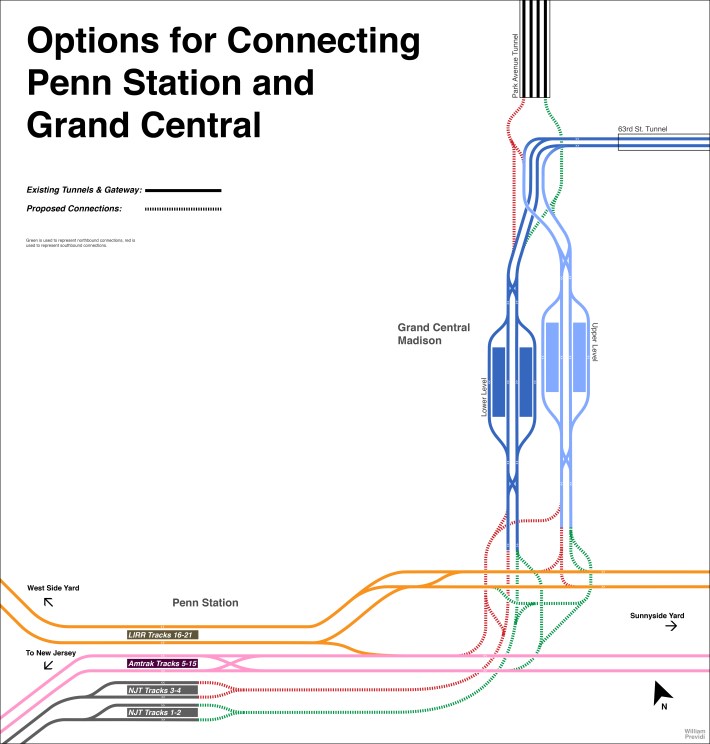
Here’s one way of doing it.

If we want a better outcome, then before Amtrak commits $18 billion to expand Penn Station, the governors of New York, New Jersey and Connecticut should create a new entity similar to the Port Authority, this time for regional rail and its first missions must be conduct a comprehensive study evaluating all through-routing options, including a link to Grand Central.

This review must be guided by strong leadership capable of conducting an unbiased technical assessment that presents the public and elected officials with phased options that can be implemented over 20, 30 or even 50 years. Doing so will in the long run save capital dollars and increase rail ridership and give people options to driving from one end of the region to the other. A previous NJ Transit report indicated we can reduce the impact of doubling capacity under the Hudson on Penn Station with a link to Grand Central.

A 2003 report, “Access to the Region’s Core,” sponsored by the Metropolitan Transportation Authority, New Jersey Transit, and the Port Authority of New York and New Jersey explored how a link to Grand Central could benefit NJ Transit customers, estimating that 36 percent of NJ Transit riders would utilize Grand Central if such a link were available.

Given that there were approximately 200,000 average weekday travelers under the Hudson River pre-COVID — and assuming the goal is to double that capacity to 400,000 daily — integrating a link to Grand Central could divert 144,000 of the 400,000 daily NJ Transit riders from Penn Station. This would unclog Penn, reduce subway crowding, and significantly lower the projected increase in NJ Transit passengers coming from the new Gateway tunnels to Penn from 200,000 a day to only 56,000. Factor in the shift of some LIRR riders to the new Grand Central link and the net growth at Penn could be zero.

To make the highest and best use of both existing rail infrastructure in the New York metropolitan region with the investment in Gateway, there must be a more holistic view of all three commuter rail systems’ current operations throughout the region and a willingness to reimagine their future as one system. In 1953, New York City’s subway system was consolidated from three separate entities—the IRT, BMT, and IND—into the unified system we know today.

The investment in doubling capacity under the Hudson River could spark a multi-year transformation of these three huge but distinctly separate operations into a seamless, truly regional vision for commuter rail in the New York, New Jersey, and Connecticut metropolitan region. The time is ripe to reexamine all possible options before it’s too late. Governors, the next step is in your hands.

Friday, July 7, 2023

Connect Penn Station and Grand Central Terminal: Linking Manhattan’s two train depots is the smartest way forward By Mysore Nagaraja, Howard Sackel and Bob Previdi New York Daily News • Jul 03, 2023 at 5:00 am


Connect Penn Station and Grand Central Terminal: 

Linking Manhattan’s two train depots is the smartest way forward

In only one year, London’s $18 billion pound ($22.4 billion) investment in the Elizabeth Line, a new rail line that crosses from west to east through central London has already carried 150 million passengers. It is the busiest line in the U.K. and is nearly equal to the 160 million annual ridership of the LIRR, Metro-North and NJTransit combined. This does not reflect well on the LIRR’s new $11 billion East Side Access project, nor Amtrak’s proposed $40 billion Gateway plan. The public needs to demand something more ambitious and connective like the Elizabeth Line if New York is spending more than $50 billion.
Unfortunately, since the LIRR’s Grand Central Madison station opened we’ve not seen as much ridership as the Elizabeth Line and it is only projected to receive 162,000 passengers when fully utilized (projection pre-COVID). Additionally, those who take the Long Island Rail Road to and from Penn Station have been complaining about a decrease in service. How can the opening of an important new terminal at Grand Central feel like a cut in service?
The answer is due to a lack of regional thinking and planning. London’s Elizabeth Line has a much broader series of ambitions than the MTA’s East Side Access and Amtrak’s proposed Gateway program. That can be changed if New York and New Jersey are ready for a paradigm shift in the way the LIRR, MNR and NJT operate through Manhattan.
Grand Central Madison’s shortcoming is that it only helps Long Islanders reach East Midtown Manhattan and does so by requiring the LIRR’s scheduling department to split the destinations from each branch, making what was previously a train every 30 minutes on the Port Washington and Babylon branches into hourly train service.
Because Penn Station and Grand Central are two separate facilities and are not linked, the only other option for increased service to Penn is for the LIRR to purchase more trains and double the number of train crews, both of which would be too costly to operate. Compare that to the success of the Elizabeth Line, which is poised to break even this year.
At Penn Station, Amtrak’s Gateway plans are poised to make a similar mistake, focused on adding capacity only for Amtrak and NJT into Penn Station. By only adding capacity to Penn Station, Gateway will not allow what NJT’s own studies have shown — that 35% of NJT riders want access to Grand Central.
London’s Elizabeth Line brings a host of local and regional travel time reduction goals together. Linking Amtrak’s Gateway and MTA’s East Side Access could have a similar huge impact on reducing travel time by rail in the New York metropolitan region as well as cut traffic congestion across the Hudson and East River bridges and tunnels, encouraging more drivers to take commuter trains instead of driving.
Physically, a link between Grand Central and Penn Station can be done — by either repositioning tracks 1 through 4 or by constructing a deep tunnel station below Penn Station thus avoiding tearing down the block south of Penn Station, known as Block 780. Then if we focus on building a connection (instead of building Penn South) to the LIRR’s East Side Access, NJT riders could reach destinations in Queens and Long Island, and LIRR and Metro-North trains can reach destinations in New Jersey.
The biggest problem here is the parochial thinking of Amtrak and the commuter rail agencies and lack of political leadership that puts customers’ needs over agencies. Someone, the mayor, the governors of New York and New Jersey or perhaps Transportation Secretary Pete Buttigieg or even President Biden, “Amtrak Joe,” needs to step up and champion this kind of thinking.
Most cities around the world invest in new and expensive rail infrastructure that improves connectivity allowing more regional access. With just one investment London’s one year old Elizabeth line has equaled the ridership of all three commuter railroads. The current investments in East Side Access and Amtrak’s Gateway are expensive and have limited growth potential. The time has come for New York to build something big that justifies a $50 billion dollar expenditure.
Making a connection between Penn Station and Grand Central that allows all three commuter rail lines to operate from one end of the metropolitan region to the other will greatly increase attractiveness of the service and usher in an era of dramatically increased commuter rail use as much as London has just shown with the Elizabeth Line.
Nagaraja is a former president of MTA Capital Construction. Sackel is a former Amtrak and Port Authority director of the Access to the Region’s Core (ARC) Project. Previdi is a former transit planner and spokesman for NYC Transit.

https://www.nydailynews.com/opinion/ny-oped-connect-penn-station-and-grand-central-terminal-20230703-hprbswddubav7j4jda2kjs6qly-story.html 


Thursday, September 30, 2021


OPINION: Biden Should Link Gateway Program and Climate Goals

The $30-billion-dollar Northeast Corridor investment could force the integration of regional rail — and lead to much less driving and flying.

The portal to the future Gateway tunnel being constructed at Hudson Yards in the west 30s in 2014. Photo: MTA/Patrick Cashin

The extreme storms that the Northeast has witnessed during the past 10 years make it painfully obvious that we can’t afford any longer simply to talk about our climate goals; we must make progress toward them. For the region’s transportation sector (the source of a third of our CO2 emissions) the method to effect those goals is fairly simple: The more people we can get to use less-carbon-intensive transportation, such as rail, bus, or bike, and the fewer people drive or fly, the better.

The Biden administration has greenlighted Amtrak’s $30-billion Gateway program — which will build two new train tunnels under the Hudson River, repair the existing two, and replace aging bridges in the Meadowlands — giving us a golden opportunity to make substantial positive change to help the environment.

But we need a more comprehensive plan.

Gateway, which will double train capacity to 48 an hour under the Hudson River, certainly will put more people on trains, but the plan focuses solely on adding capacity to Amtrak and NJ Transit’s operating territory. Designing to meet climate goals can’t be so rigid. If rail is to compete with our interstate highways, Gateway must serve more than just Amtrak and NJ Transit customers’ needs, and help our local railroads to become a truly interconnected regional system. A regional design could be a watershed moment for the nation if the investment in it truly advanced the vision of the Paris Climate Accords by reducing transportation’s carbon footprint.

President Biden could put a stamp on his legacy if he could force the issue. By linking the Gateway investment to the broader climate goals of reducing air and road travel in New York and along the Northeast Corridor, Biden could encourage more concrete steps that could lead to the lessening of CO2 emissions from vehicles using the facilities of the Port Authority of New York and New Jersey (including its airports), Metropolitan Transportation Authority bridges and tunnels, and other regional highways.

As a meaningful first step, Biden must ask New York and New Jersey to create a regional climate-action plan. There already is a vehicle: the Port Authority, the bi-state agency the Congress authorized 100 years ago in order to facilitate interstate commerce, is the best positioned of all regional transport agencies for the task because ion its size and its mandate to work across state lines. It could look at the current plans for Gateway and at climate goals and sit in a room with all transportation agencies and ask the basic questions that will induce more rail use and reduce the demand for car and air travel. (Indeed, the ideas that became Gateway originated in a 1995 major-investment study, Access to the Region’s Core, led by the Port Authority but also involving the MTA and NJTransit.)

If we want fewer people to choose to travel by car or airplane, then the regional services must make train travel attractive and convenient by simplifying operations through Penn Station. East Side Access, slated to open in 2022, will link the LIRR to Grand Central Terminal. But it has the same issue as Gateway: It adds capacity, but does not address regional travel demand with the goal of shifting drivers into rail cars.

When Amtrak took over the Penn Central Railroad in 1971, it gained tracks that spanned the country, including the Northeast Corridor, the nation’s most heavily trafficked rail corridor and one on which many local commuter railroads rely. In fact, of the 800,000 daily riders that use the Northeast Corridor, only 40,000 are Amtrak passengers, according to a recent Northeast Corridor Commission report.

Although Amtrak owns the Northeast Corridor, it does not control how local commuter-rail systems may use its tracks. Most rail-traffic congestion in New York’s Penn Station comes from commuter trains constantly crossing each other’s paths, changing direction and basically getting in each other’s way. This confusing system does not give people in New Jersey easy access to Long Island, the Bronx, Westchester or Connecticut — and visa versa.

The current, more than 100-year-old Gateway rail tunnel needs replacement. Photo: File photo
The current, more than 100-year-old Gateway rail tunnel needs repair. Photo: File photo

In order for our local commuter railroads to knit themselves into a truly regional system, those services must operate beyond the limited boundaries that confine NJ Transit, the Metro-North Railroad, and the Long Island Rail Road today. A unified approach in planning, building and operating the greater capacity envisioned by the Gateway project could create such consumer and environmentally friendly options. Yet there is no plan to bring it all together.

The Regional Plan Association has talked about it for years, including in its most recent report, which “envisions a series of new projects, phased in over the next few decades, to unify the commuter rail system and expand it into a seamless regional transit system.” The RPA called it the Trans-Regional Express (or T-REX), which would “provide frequent, reliable service, directly connecting New Jersey, Long Island, the Mid-Hudson, and Connecticut, create new freight-rail corridors, and provide additional transit service to riders within New York City.”

The RPA and other advocates posit an integrated systems along the lines of the RER in Paris or London’s Elizabeth Line/Crossrail, which is scheduled to open in 2022. But in order to create a local analog of the RER here in New York and meet climate goals, planners must expand the design of Gateway beyond its immediate goals and extend it to include climate objectives.

To get working on this vision, however, we’d need an organizational push among city, state and federal officials, and transport agencies, the likes of which we’ve never seen. Biden must work closely with Sen. Schumer of New York and Sen. Booker of New Jersey in order to set the stage for the Port Authority to take the necessary steps to wean itself and the other agencies away from relying on tolls and parking and landing fees. The Port Authority could take the lead, yet without any interagency or interstate plan we are kidding ourselves that we will make any meaningful progress toward our transportation-sector CO2-reduction goals. We must use the $30-billion investment in Gateway’s development as a lever.

Time is running out to create a workable plan if we are to maximize the Gateway investment for the benefit of the region and our climate.

Bob Previdi is a transit consultant and a former planner and spokesman for NYC Transit. Mysore Nagaraja is a consultant and former president of MTA Capital Construction. Howard Sackel is a consultant and former director of the Port Authority’s ARC project.

Monday, June 10, 2019


 UPDATED 3 HOURS AGO

A radical idea for Cuomo's transit panel

Merge our railroads to end turf battles, save billions and make travel seamless

Buck Ennis
Turf wars and narrow thinking inflated the cost of East Side Access.
Gov. Andrew Cuomo has asked for a review of the East Side Access transit megaproject to learn why it costs so much. The same question could be asked of Amtrak's Gateway. In fact, the mistakes made in the design of East Side Access could be avoided in Amtrak's project if our railroads work together.
This is no small task. It would require a tunnel between Penn Station and Grand Central Terminal and an agreement for New Jersey Transit, Metro-North and Long Island Rail Road to seamlessly share it. It sounds ambitious, but it would ultimately save money while enhancing riders' access to the region.
Lack of cooperation between our various rail agencies delays projects and inflates costs. Consider East Side Access, which will connect the LIRR to Grand Central: Conceived in the 1950s, it was started and stopped in the 1970s and restarted in 2007. It has seen the opening date pushed back nearly a decade, to 2022, and costs triple, to $11 billion. One reason for this outrageous sum is that the LIRR had to build an eight-track facility 100 feet beneath Grand Central because Metro-North did not want to share the terminal—despite both railroads being divisions of the Metropolitan Transportation Authority.
The same issue is bubbling up on Gateway. When NJ Transit was working on Access to the Region's Core, a project Gov. Chris Christie canceled in 2010, it found that 35% of its riders wanted access to Grand Central. But it could not get permission to share Metro-North's Grand Central or LIRR's East Side Access. Gateway has that problem too. As a result, NJ Transit plans to build six tracks south of Penn Station, costing billions of dollars.
Connecting the operations of the railroads would simplify Penn Station's operations and eliminate the need for Penn South, where trains would merely turn around. For Cuomo and Gov. Phil Murphy, connecting these two initiatives would be an achievement on par with the merger of the subways in 1947.
Riders west of the Hudson would get one-seat access to Grand Central, Citi Field and LaGuardia and JFK airports. LIRR riders could take one train to Newark airport and Met Life Stadium. The congestion at Penn Station would be eliminated as the railroads figure out how to run trains between New Jersey and Long Island rather than terminate in Manhattan.
The MTA and NJ Transit already have a cooperation agreement for service on the Port Jervis and Pascack Valley branches of Metro-North. This can be a model. Other issues related to power, signals and the training of crews would need to be resolved, but that beats the alternative of spending billions digging out a station beneath Manhattan.
Merging transport agencies is not a new concept. The subway merger combined three distinct operators: the Interborough Rapid Transit, Brooklyn Manhattan Transit and Independent Subway lines. Paris integrated its commuter-rail systems in 1977. Philadelphia combined the Reading and Pennsylvania commuter lines in 1984, and Boston just finished a study to connect North and South stations. London has already opened Thameslink (a north–south link) and is in the final stages of building Crossrail (an east–west route). It can be done.
The costs for East Side Access got out of control because we did not think regionally and make the highest and best use of Grand Central Terminal. Cuomo could apply that lesson to Gateway and avoid the boondoggle that would be Penn South by finally linking Penn Station to Grand Central.
Joining the goals of East Side Access and Gateway will force greater cooperation between the railroads and make commuter rail in New York more customer-friendly and regional, as it is in Paris, London and Philadelphia.
The governor is right to review East Side Access. But he must add Gateway to his inquiry and chart a future that puts customers and taxpayers first. 
Bob Previdi is a transportation lobbyist and a former planner and spokesman at NYC Transit.